Richard Linklater's 'Blue Moon' Offers a Poignant and Powerful Glimpse into the Final Act of an Artist
- Brad Willows

- Oct 27, 2025
- 6 min read
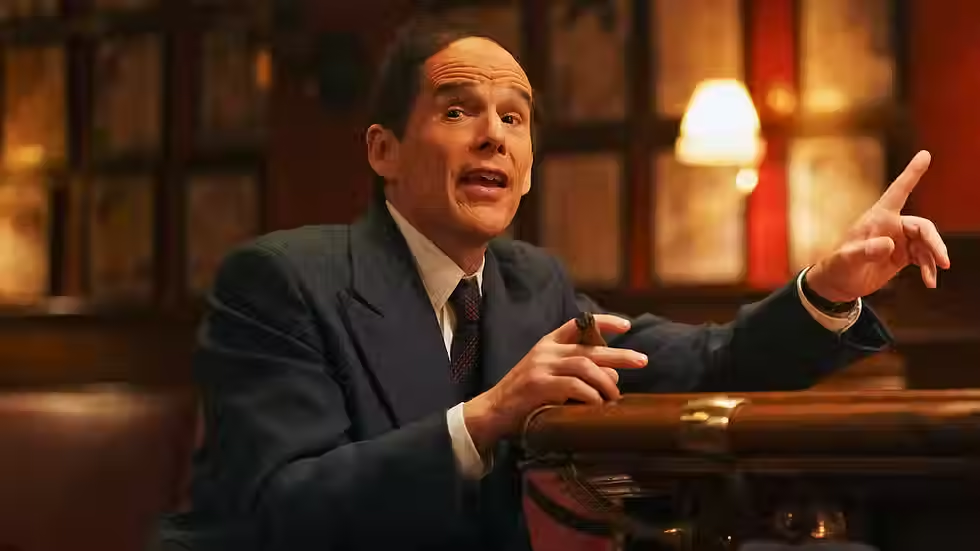
The enduring and profoundly fruitful cinematic collaboration between director Richard Linklater and actor Ethan Hawke, stretching back three decades to Before Sunrise, continues with this transfixing character study. That iconic trilogy, filmed across 27 years, along with the decade-long, sporadically shot Boyhood, provided both men with an intimate understanding of artistic symbiosis. This shared history lends a poignant emotional resonance to their reunion in Blue Moon, a film that keenly scrutinizes the fragile skeleton of a creative partnership of comparable longevity.
Set in the storied world of Broadway, the film is adapted from a wryly humorous and perceptive script by Robert Kaplow, whose novel also served as the basis for Linklater's 2008 feature, Me and Orson Welles. The narrative unfolds in real time on March 31, 1943, the legendary opening night of Oklahoma!, the genre-redefining musical that would go on to run for five years. However, the film bypasses the creative team of that landmark production, choosing instead to focus on the renowned lyricist Lorenz Hart (Hawke). While the New York theater elite toast the overwhelming success of his composing partner of more than two decades, Richard Rodgers (Andrew Scott), Hart is down the street at Sardi’s, systematically pickling himself with bourbon.
Oklahoma! marked the first musical on which Rodgers collaborated with a different partner, the librettist and lyricist Oscar Hammerstein II (Simon Delaney). A gentle undercurrent of pathos feeds the sparkling banter of Blue Moon, drawn from the audience's knowledge that Hart would tragically die just eight months later at the age of 48, succumbing to pneumonia four days after being discovered shivering in the gutter outside a favored Eighth Avenue bar. The layered character study acquires additional emotional weight from the historical fact that Rodgers and Hammerstein would ascend to become one of the most celebrated and successful creative teams in the history of musical theatre, ultimately eclipsing the legacy of Rodgers and Hart.
This is not to say that the latter duo left no cultural footprint. Their popular shows included A Connecticut Yankee, Babes in Arms, The Boys From Syracuse, and Pal Joey. More notably, they gifted the world a bulging catalogue of standards absorbed into the Great American Songbook, such as “My Funny Valentine,” “Bewitched, Bothered and Bewildered,” “Manhattan,” “The Lady is a Tramp,” and the song that gives the film its title, “Blue Moon.”
With the exception of a brief opening shot showing Hart collapsing in the rain-swept alley where a friend eventually found him before his final hospitalization, and one short scene outside the restaurant, the entire film is contained within Sardi’s, the famed theatre district haunt. The single external scene depicts Hart in a box at the St. James Theatre, rolling his eyes and groaning to his mother before slipping out to find a drink during the title song of Oklahoma!. Production designer Susie Cullen created a remarkably convincing facsimile of the popular restaurant in Ireland for the shoot.
The rest of the film remains entirely in the dining room and bar. While Linklater makes no effort to disguise the static nature of the setting or the inherent theatricality of the material—which could easily translate to the stage—he remains a director who possesses few equals when it comes to maintaining the buoyancy of a dialogue-heavy picture, a skill honed to perfection across the Before trilogy. This sense of dynamic engagement is achieved not only through the dexterity of regular cinematographer Shane F. Kelly’s camera work, which skillfully weaves around the space, playing with spatial dynamics to maintain visual interest, but also through the superb casting.
The actors, particularly Hawke and Margaret Qualley, who plays Elizabeth Weiland—a 20-year-old Yale student whom Hart introduces as his protégé while harboring delusional hopes of a romance, despite the lyricist being unequivocally gay in this telling—find genuine music in their reams of dialogue. Scott has fewer lines as Rodgers, yet he is such a sensitive actor that he flawlessly conveys the composer's rush of fresh professional triumph, simultaneously showing kindness and generosity toward the collaborator to whom he freely admits he owes his career. At the same time, the newly successful Dick lays down a firm professional boundary with Larry, insisting that if they are to collaborate on a new version of A Connecticut Yankee, the lyricist must demonstrate total discipline, meaning an end to his drinking-induced disappearances.
The very appearance of the two actors instantly pinpoints their characters’ opposing career trajectories. With his slightly disheveled formal wear and greasy combover, Larry is clearly past his peak, while Dick, dashing in his crisp tuxedo, is the glowing picture of health and success. Even at a low ebb, Larry manages to project a decent façade of confidence and has full command of his razor-sharp wit. When he sits at the bar to chat with bartender Eddie (Bobby Cannavale, embodying his usual grounded affability), the Sardi's staffer has the professional geniality required of his job, but he has also witnessed enough of Larry at his worst to gently remind him he should not be serving him liquor. Hawke channels a devilish spark in his eyes as he coaxes Eddie into pouring him a shot and then leaving the bottle for him to "admire," a promise of temperance that quickly proves hollow.
Hawke’s performance deftly balances Larry’s charming side with his seediness. He is a natural raconteur, entertaining Eddie and the enlisted Army pianist he nicknames Knuckles (Jonah Lees) before the post-show crowd begins pouring in. He flirts with a handsome young flower delivery man, insisting he attend a party at his apartment later that night, and launches into a marvelous, snarky critique of the use of an exclamation point in a show title. He also strikes up a convivial conversation with another customer, E.B. White (Patrick Kennedy), an initially reserved essayist who seems to appreciate the verbally incontinent Larry’s humor. White, who is somewhat burnt out on essay writing and transitioning into children’s books (he would go on to write the classics Stuart Little and Charlotte’s Web), is one of a handful of famous contemporary figures who either appear or are mentioned. Others include the New York photographer Weegee (John Doran) and a precocious young boy accompanying his mentor Hammerstein, identified only as “Little Stevie” (Cillian Sullivan)—a reference that theatre aficionados will instantly recognize as the 13-year-old Stephen Sondheim.
When Dick and Oscar arrive to a hearty round of applause, Larry praises Oklahoma!, striking a markedly different tone from his earlier dismissive comments about the show's artistic merits. While he has too much pride to grovel, he is gracious toward his old friend and demonstrates an eagerness tinged with desperation as he persistently waylays Dick to talk with feverish excitement about potential new projects to rekindle their partnership. Hawke is wonderful in these exchanges, subtly exposing the damaged inner life of a man who may secretly suspect his best work is behind him but is desperately trying to convince himself otherwise. The smallest trace of a wince crosses his face whenever Hammerstein reads another ecstatic review snippet as the news comes in.
An equal portion of Larry’s attention is directed at Elizabeth, the daughter of a member of the influential Theatre Guild, who has her own society hobnobbing to attend to. She disappears to mingle when the opening-night party moves upstairs but returns to spend time with Larry, whose hunger to live vicariously through her account of sex with a college heartthrob does little to conceal his sexual "proclivities." Yet, one of the most touching dualities of Hawke’s performance is his ability to channel Larry’s suppressed queerness while still entertaining the romantic fantasy of a future with Elizabeth. Qualley’s eyes convey both tenderness and compassion as she utters the words no man wishes to hear but which Larry could easily have predicted: “I love you, just not in that way.”
Blue Moon is a deceptively modest undertaking, yet it is beautifully executed and fascinatingly nuanced despite its straightforward plot. The film offers trenchant observations on the delicate give-and-take of creative collaboration; the fickle, often insular embrace of the New York theatrical community; the surprisingly safe space that environment provided for gay men, even if their lives were seldom openly discussed; and the enduring solitude of the closet, which even that tacit degree of acceptance often failed to alleviate. Furthermore, in ways many audiences can likely relate to, even if reluctantly, the movie is an honest reflection on the conflicted feelings one might experience upon witnessing the success of friends or colleagues in the same professional field. It stands as another satisfying and characteristically idiosyncratic entry in the highly fruitful collaboration between Hawke and Linklater.