'F1: The Movie' Accelerates Audiences Deep into the World of Grand Prix Racing
- Jonathan Parsons

- Jun 16, 2025
- 4 min read
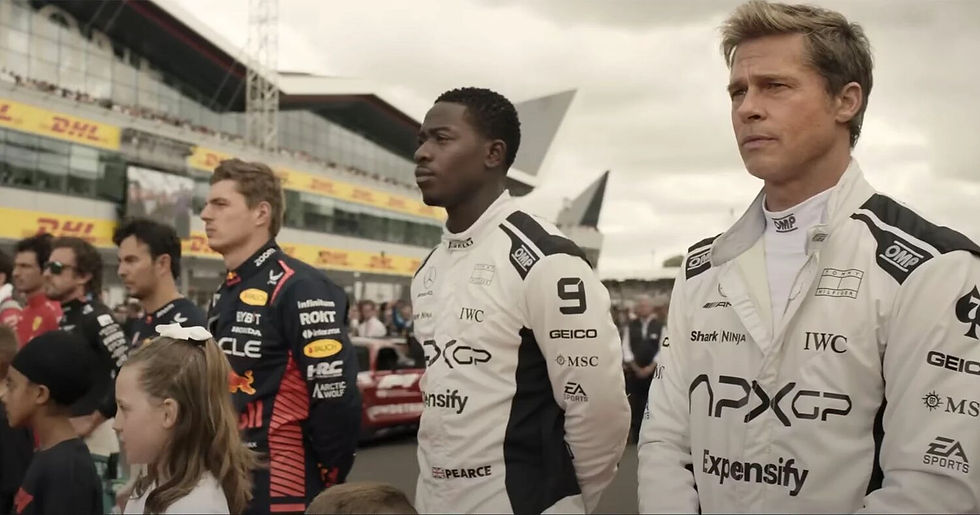
The global popularity of Formula 1 racing, significantly bolstered by the Netflix docuseries Drive to Survive (which premiered in 2019 and gained traction during the pandemic, introducing terms like Grand Prix, brands like Ferrari and Red Bull, and drivers such as Lewis Hamilton to a wider American audience), has paved the way for a major cinematic exploration of the sport. Director Joseph Kosinski's F1: The Movie, which is scheduled for a theatrical release on June 27 before moving to Apple TV+, is a thrilling and remarkably deft addition to the established canon of motorsport films, standing alongside works like Rush and Ford v Ferrari.
What distinguishes F1 is Kosinski’s ability to seamlessly integrate the intense realities of Formula 1 into his fictional drama. Reuniting with his Top Gun: Maverick screenwriter Ehren Kruger and cinematographer Claudio Miranda, the director crafts a high-octane adventure centered on the late-career comeback of a once-promising premier motorsport driver. The production went to extraordinary lengths to capture authenticity, filming over eighteen months during more than a dozen real Grands Prix races. The lead actors drove actual F1 race cars, and Miranda and Kosinski experimented with camera placement to precisely translate the addictive, life-on-the-edge energy of the sport. Crucially, the film succeeds in placing the viewer directly in the car, conveying the exhilarating proximity to mortal danger that defines Formula 1.
The central narrative tension, which Kosinski masterfully exploits, mirrors the dramatic reality established by Drive to Survive: the constant, cutthroat conflict between individual glory and team success, often measured by leads as narrow as a tenth of a second.
The formidable cast, led by a fine Brad Pitt and the compelling Damson Idris, anchors the story. Pitt plays Sonny Hayes, a former professional motorist who lives for driving. When introduced, he is competing in the 24 Hours of Daytona endurance race, where his success is purely transactional—securing the lead, collecting his paycheck, and planning a low-profile road trip to Ensenada for an undisclosed driving job.
Sonny's cross-country plans are intercepted when he encounters his old friend and former teammate, Reuben (Javier Bardem), who now owns the struggling Formula 1 team APXGP. A desperate Reuben begs Sonny to become the second driver to his rookie star, Joshua Pearce (Damson Idris, excellent), arguing that the team must secure a single race win or the board will dissolve APXGP and fire him.
Sonny is hesitant, still reeling from a near-fatal crash thirty years prior in Spain, memories of which are vividly evoked through Stephen Mirrone’s nimble cross-cutting. Reuben recognizes Sonny's lingering talent and encourages him, noting that the older driver's maturity and discipline could be an asset to the team. After some playful goading, Sonny agrees to help.
The film explores the challenges faced by an older driver attempting to regain footing in a sport dramatically changed since his heyday. Beyond the thrilling race sequences, the most exciting elements of F1 examine the intergenerational friction between Sonny and Joshua, as well as the commercial evolution of the sport. F1 has always been costly (teams frequently pay half a million dollars for drivers to compete), but modern athletes must also cultivate an appealing public image off the track to maintain relevance. Sonny couldn't care less about this aspect, but Joshua, who is portrayed as one of two Black drivers in this fictionalized league, cannot afford the same attitude.
Lewis Hamilton, the sport's real-life first and only Black driver, co-produced F1 and appears as himself. A poignant moment near the finale features his character locking eyes with Joshua before a race, subtly acknowledging the issue of diversity and gesturing toward a more inclusive future for the prohibitively costly sport. While Kruger’s screenplay touches upon these issues, the nuances could be more robustly developed, especially given the monumental real-life significance of having two Black drivers in the sport. A deeper interrogation of what it means for this pairing of underdogs—the Black Brit and the American, both outsiders in a largely European sport—to collaborate is suggested but not fully realized, leading their relationship at times to lean into conventional archetypes.
Joshua is given robust characterization, including memorable scenes with his mother, Bernadette (Sarah Niles), a fierce protector who nonetheless recognizes her son's ego often leads to ageist comments. Bernadette, channeling a protective energy reminiscent of Deloris Jordan (as portrayed by Viola Davis in Air), is humorously shown forcing Joshua to apologize to Sonny for disrespecting the older driver during a press conference.
Sonny and Joshua initially clash because their similarities are deeper than they realize. Joshua's brash confidence masks a self-protective attitude forged by hard work, a fear that Idris channels effectively through understated physicality and subtle facial expressions. Pitt plays his hardened protagonist like a rugged cowboy in the luxury Wild West of F1, opting for rugged denim costumes (designed by Julian Day), contrasting sharply with Joshua’s clean-cut, runway-ready looks.
The majority of F1 chronicles the transformation of their mutual hostility into a healthy competitive spirit. Each Grand Prix serves to advance their unlikely friendship and educate viewers on different facets of the sport. Early races focus on the mechanics, speed, and money, where Sonny meets lead engineer Kate McKenna (Kerry Condon), the first and only woman in her position, whose success is critical to disproving her doubters. He also interacts with team principal Kaspar (Kim Bodnia) and the eager but slippery board member Peter Banning (Tobias Menzies).
Later races shift focus from the mechanical to the emotional, illustrating how every team member—from drivers to pit workers—must collaborate and self-regulate, adhering to the principle that "slow is smooth, and smooth is fast." These race weekend scenes, during which Kosinski embeds his fictional team with real F1 operations, are the film’s strongest element. Fans of the sport will recognize cameos from drivers including Max Verstappen, Charles Leclerc, Carlos Sainz, and Lando Norris. Hans Zimmer’s adrenalized score heightens the tension of every nail-biting moment, from dangerous turns on slick courses to the mere seconds mechanics have to switch out tires in the pit.
The impressive craftsmanship extends to the exploration of F1 technologies, such as road simulators used to gain competitive advantages. While the film, with its two-and-a-half-hour runtime, contains some unrealistic elements that may raise professional eyebrows, F1: The Movie remains as dramatically compelling as the real sport itself.