Alex Scharfman Presents Tapestry of Terror In Bold Debut, 'Death of a Unicorn'
- Jonathan Parsons

- Mar 10, 2025
- 4 min read
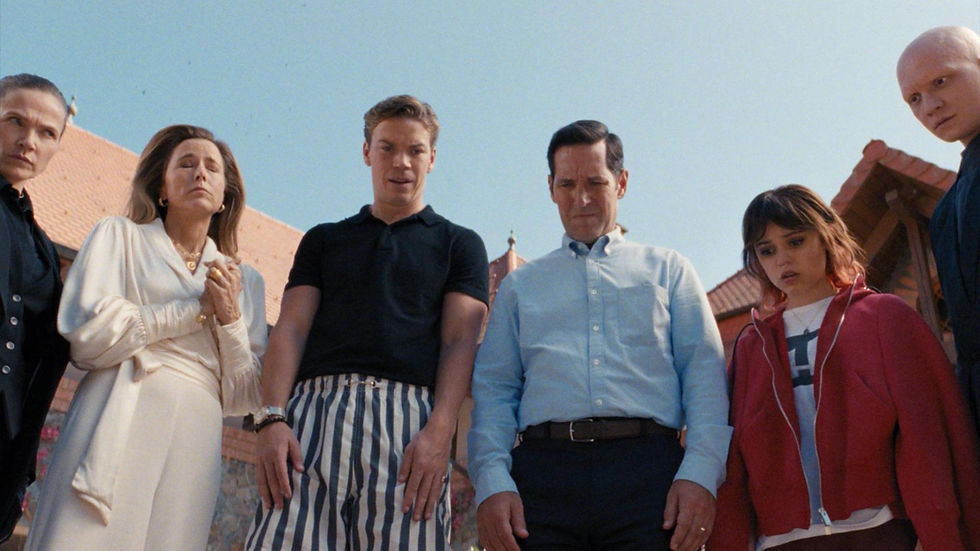
The famed Unicorn Tapestries, seven intricate panels permanently housed at The Cloisters in New York, have long been a focal point of scholarly debate, vividly detailing the capture of a mythical creature by hunters and its eventual taming by a virgin. For decades, art historians have intensely debated their meaning, with early interpretations suggesting metaphors for marriage and fertility, later giving way to the more enduring allegorical reading of Christ. In his directorial and screenwriting debut, Death of a Unicorn, producer Alex Scharfman (known for House of Spoils and Resurrection) posits a universe where these magical entities are terrifyingly real, and the tapestries themselves serve as a prescient warning.
This highly anticipated A24 release, which debuted at the SXSW film festival, stars Paul Rudd and Jenna Ortega as a father-daughter duo thrust into an extraordinary and horrifying predicament. The central figures are Elliot (Rudd), a compliant, allergy-prone lawyer, and his college-aged daughter Ridley (Ortega), who are on their way to a crucial meeting with a pharmaceutical magnate. During their drive, they collide with a unicorn. While an ordinary wildlife accident would be traumatic, a collision with a creature of myth proves far more psychologically disturbing. Upon exiting their SUV to assess the damage, Ridley experiences a kitschy, psychedelic sequence suggesting a spiritual connection with the creature, while the fearful Elliot brutally ends its life by repeatedly smashing its head.
With this gruesome opening sequence, Scharfman instantly establishes Death of a Unicorn as a piece of absurdist horror anchored by a familiar vein of social satire. Elliot, a hardworking man still grappling with the grief of losing his wife, has enlisted Ridley to join him for a weekend with his dying boss, Odell. The tycoon, played by Richard E. Grant in a performance reminiscent of his role in Saltburn, is preparing to name a proxy for his company’s board, and Elliot strikes him as the perfect candidate. The CEO invites Elliot and Ridley to his sprawling, isolated estate to spend a few days with his family, ostensibly to gauge Elliot’s character and test his corporate loyalty—a setup audiences immediately recognize as a clear precursor to trouble, given the recent boom of "eat-the-rich" satires.
Upon their arrival, Elliot and Ridley are introduced to Odell’s wife, the philanthropic Belinda (Téa Leoni), his wayward, entitled son Shephard (Will Poulter), and the household staff, including a stoic bodyguard (Jessica Hynes) and an overworked butler (a scene-stealing Anthony Carrigan). The primary action is ignited when the Leopold family discovers the unicorn’s miraculous curative properties and immediately begins plotting ways to exploit and monetize them. They summon the company’s top researchers (Sunita Mani and Stephen Park) and enlist everyone present in their mercenary scheme. Ridley, a proclaimed art history major, remains deeply skeptical. She initiates her own investigation into the creature’s lore, and her findings foreshadow a gruesome fate for all involved.
Death of a Unicorn starts strong with its ambitious, gonzo premise, but the narrative’s momentum quickly begins to flag. Scharfman largely adheres to the established framework of the social satire genre, following a predictable playbook seen in films ranging from The Menu to Triangle of Sadness. While the movie delivers a sufficient number of absurd set pieces, the fundamental plot lacks surprising twists. A missed opportunity arises when Ridley briefly investigates the history of the seven tapestries, an angle that could have provided a fresh, experimental approach to unicorn mythology, yet Scharfman elects to gloss over this crucial lore.
This background information would have been particularly useful when the mixed-income ensemble is forced to battle more of the mythical horses. Scharfman stages undeniably entertaining scenes with the CGI-rendered creatures, gleefully recasting them as merciless killing machines and indulging in the various ways these regenerative beasts can be dispatched. However, the internal logic governing the unicorns’ behavior often shifts to suit the plot’s convenience, making it challenging for the audience to fully invest in the escalating stakes.
The film is primarily carried by the committed performances of Scharfman’s expertly assembled cast. Grant, Leoni, and Poulter are excellent as the one-percenters, brilliantly portraying a cruel self-interest masked by an exaggerated performance of generosity. Their relationship with the butler, Griff, is a particularly humorous subplot, allowing Carrigan (of Barry fame) to bolster a relatively thin role with nuanced physical comedy and impeccable timing.
Adding an understated sweetness to Scharfman’s dark film are Rudd and Ortega. Their relationship, initially fractured by the profound sadness of a loss, develops meaningful emotional resonance over the course of their unlikely adventure. The pair channel a convincing father-daughter chemistry that lends genuine poignancy to a crucial penultimate scene. It is within this relationship that Death of a Unicorn ultimately finds its most unique voice and offers a novel approach to a familiar satirical framework. Prior to hitting the unicorn, Elliot and Ridley struggled to navigate the rough emotional landscape of their grief, their conversations awkward and splintered by the suddenness of an untimely death. Even when sharing space, they seemed to exist on different emotional planes. While their harrowing adventure may not fully heal their wounds, it does succeed in helping them see one another with greater clarity.