A Beautiful Mess: Why Luca Guadagnino's After the Hunt Drowns in Its Own Ambiguity
- Brad Willows

- Oct 13, 2025
- 3 min read
Updated: Oct 13, 2025
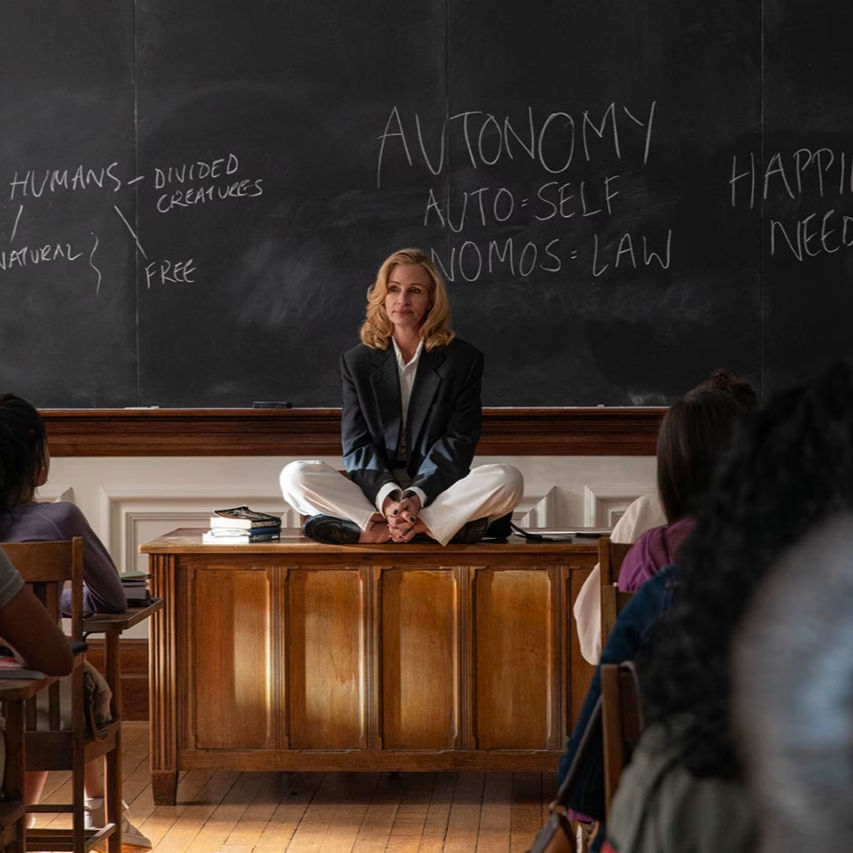
Luca Guadagnino's latest film, After the Hunt, dives headlong into the treacherous, morally ambiguous waters of contemporary academic and social dynamics, specifically the fallout of a sexual misconduct allegation on a prestigious university campus. Bolstered by a star-studded cast including Julia Roberts and Andrew Garfield, the film attempts to dissect issues of power, privilege, generational conflict, and accountability in the #MeToo era. The result is a messy, beautiful, and deeply polarizing psychological drama that aims to be a provocative conversation piece but often drowns in its own deliberate ambiguity.
The film is set at Yale University and centers on Alma Imhoff (Julia Roberts), a highly respected and ambitious philosophy professor who is fiercely protective of her controlled life and on the verge of tenure. Her seemingly perfect world—shared with her witty psychiatrist husband, Frederik (Michael Stuhlbarg)—begins to unravel after a dinner party.
Alma's star PhD student, Maggie Price (Ayo Edebiri), who is also the daughter of major university donors, shows up on Alma's doorstep the next day with a terrible accusation: she claims that Hank Gibson (Andrew Garfield), Alma’s close friend and academic rival for the coveted tenure spot, sexually assaulted her after walking her home.
The film then becomes a tense psychological thriller as Alma is forced to choose between her loyalty to Hank, her duties as a mentor to Maggie, and her own self-preservation. As the campus scandal begins to boil, a secret from Alma's own past—involving a prescription drug addiction and a prior claim of abuse—threatens to destroy her career and force her to confront the very ethical frameworks she teaches. The narrative intentionally blurs the line of truth, with characters manipulating events and one another, leaving the audience to grapple with the messy, irreconcilable conflicts that exist "after the hunt" for justice has begun.
After the Hunt premiered out of competition at the 82nd Venice International Film Festival and was later the opening night film for the New York Film Festival (NYFF). It began its domestic run with a limited release by Amazon MGM Studios on October 10, 2025.
Its opening weekend gross from this limited release, across six theaters, totaled $154,467. This yielded an average of $25,745 per theater. While a per-theater average over $25,000 is generally considered a strong start for an arthouse limited release, the film’s high profile and major star power led some box office analysts to suggest it underperformed initial expectations, anticipating a softer expansion given the polarizing critical reviews.
After the Hunt is a cinematic experience that is both a feast for the eyes and a frustration for the mind.
Guadagnino, working with cinematographer Malik Hassan Sayeed, crafts a gorgeously dreary, oppressive atmosphere. The Yale campus and Alma’s luxurious apartment are shot in murky, reflecting light, imbuing the prestige of academia with a palpable sense of rot and psychological decay. The film has the visual texture of a high-end European thriller—lush, tense, and impeccably styled, from the art on the walls to Roberts’s sharply tailored wardrobe.
The performances, particularly from the central trio, are a major draw. Julia Roberts delivers one of her most complex and tightly-wound performances in years, using her legendary star power to play a character who is almost repellently self-contained and morally compromised. Andrew Garfield weaponizes his natural charm to make Hank’s casual entitlement and self-pity chilling. Ayo Edebiri, though hampered by a script that sometimes sidelines her character's voice, portrays Maggie's hurt and calculating need for validation with an unnerving, deliberate ambiguity.
However, the film’s fundamental weakness is this: Nora Garrett's first-time screenplay. The film’s ambition to be a definitive statement on the complex intersection of #MeToo, race, class, privilege, and generational differences (Gen X versus Gen Z) ultimately proves to be its undoing.
Instead of a nuanced debate, the dialogue often descends into overly-intellectualized, on-the-nose exposition. Characters, meant to be brilliant philosophers, speak in sweeping generalities and theatrical metaphors, turning their conversations into a pretentious echo chamber. The film seems so worried about being "cancelled" for taking a clear stance that it equates a potential sexual assault with Alma's comparatively minor crime of forging prescriptions, and Maggie’s privileged-yet-traumatized background with Hank's predatory behavior. In an attempt to achieve a lofty moral ambiguity, the film is often accused of resorting to "behind-the-scenes cowardice," simply refusing to commit to its themes.
After the Hunt works best not as a social commentary or a #MeToo procedural, but as a darkly absorbing, yet tonally muddled, psychological portrait of flawed intellectuals cannibalizing one another in a bid for career survival. It succeeds in being provocative—even "borderline trollish" in its Woody Allen-esque opening credits—but it fails to offer the intellectual rigor needed to explore its incendiary themes meaningfully. While Roberts and Guadagnino's signature style keep you watching, the film ultimately leaves you with a feeling of profound dissatisfaction, not because the characters are messy, but because the narrative itself is. It's an important, frustrating time capsule of a cultural moment, but not the masterpiece of contemporary cinema it aspires to be.